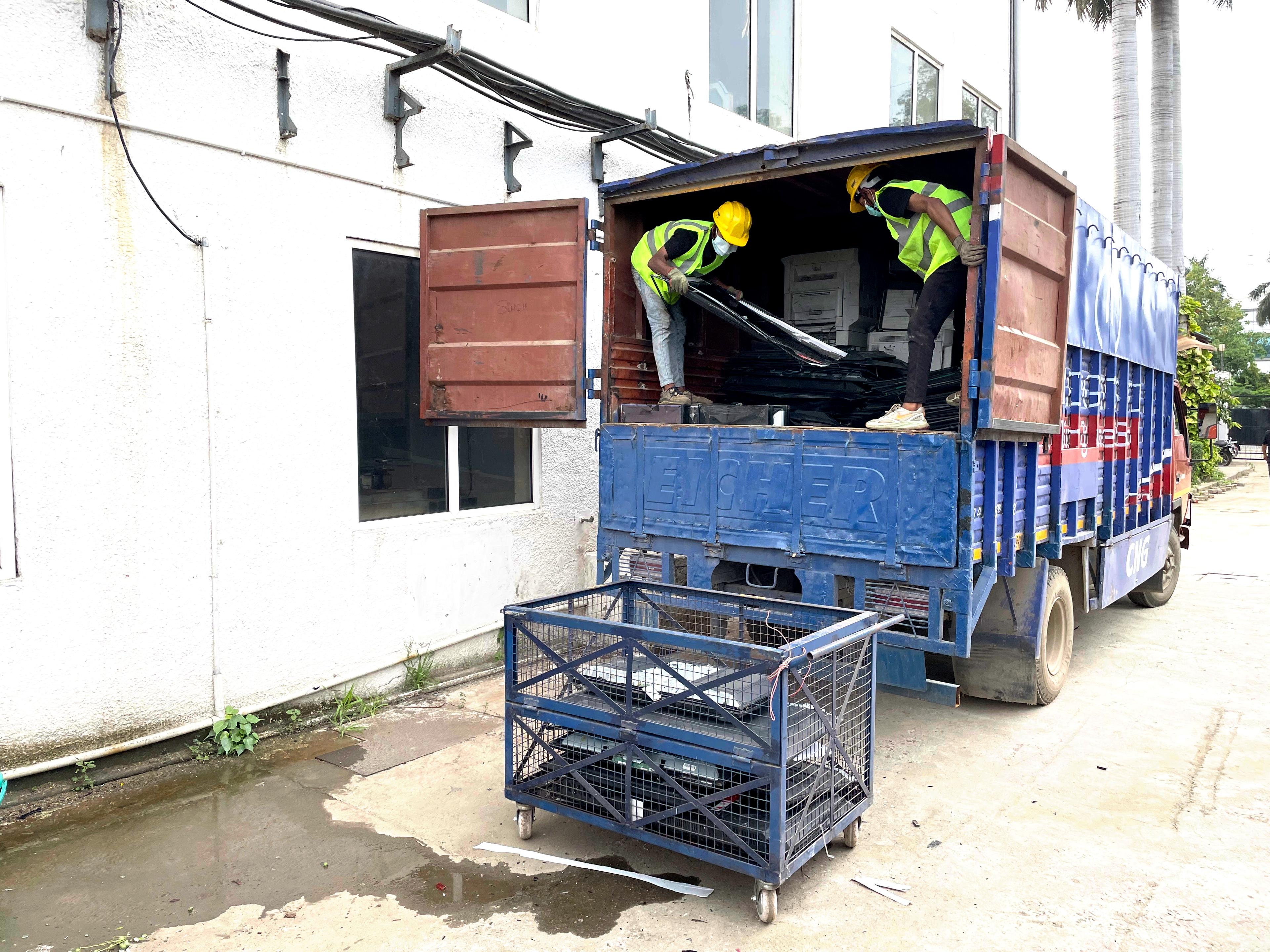
The mechanics, additionality, and standards of e-waste compensation
 Stefan de LindeFounder & CEO
Information regarding electronic waste compensation is scattered across technical working papers, development agency publications, and operational pilot summaries. This fragmentation makes it difficult for corporate sustainability teams, public procurement officers, and circular economy professionals to understand what the mechanism entails, how it functions, and where its limits lie. This article aggregates established technical standards, field data, and regulatory intersections into a consolidated technical reference.
What is e-waste compensation?
E-waste compensation is a voluntary circular mechanism where the sale or procurement of electronic equipment finances the verified collection and sound treatment of an equivalent volume of end-of-life electronics in regions lacking formal waste infrastructure. The process specifically targets post-consumer equipment that has exhausted all repair and reuse potential, guaranteeing that hazardous and zero-value material fractions are safely processed rather than dumped or open-burned.
The global e-waste baseline and informal recovery dynamics
Electronics represent the fastest-growing solid waste stream in the world. According to the Global E-waste Monitor 2024, published jointly by UNITAR and the International Telecommunication Union (ITU), the world generated 62 million metric tonnes of electronic waste in 2022. Only 22.3 percent of that total was documented as formally collected and recycled in an environmentally sound manner.
The data demonstrates that global e-waste generation is expanding five times faster than documented formal collection and recycling capacities. In low- and middle-income regions, the gap is wider: less than 1 percent of electronic waste generated across the African continent is documented as formally collected.

The crisis in regions lacking formal management infrastructure stems from material economics rather than an absence of scrap collection. Informal waste pickers actively collect electronic waste to recover commercially valuable metals. Printed circuit boards, copper cabling, and aluminum heat sinks command high prices in secondary raw material markets.
However, electronic equipment also contains hazardous substances and fractions with negative economic value. Cathode-ray tube glass, mercury lamps, brominated flame-retardant casing plastics, and degraded battery chemistries yield no scrap profit and carry steep processing costs. When informal collectors harvest the copper or circuit boards, they routinely discard or open-burn the remaining components to extract trace metals. This practice releases persistent organic pollutants, heavy metals, and dioxins into surrounding air, soil, and waterways.
The additionality requirement and hazardous fractions
Standard commercial metal recovery fails to qualify as electronic waste compensation. Under circular accounting principles, an intervention must deliver additionality, defined as an environmental outcome that would not have occurred without the financial contribution of the compensation scheme.
The Öko-Institut explored these economic dynamics in its research on circular business models in the e-waste sector. Because the informal market already collects valuable metals, subsidizing copper recovery alone produces no additional ecological benefit. True additionality requires service providers to finance the end-to-end management of whole devices, ensuring that the low-value and hazardous fractions receive environmentally sound treatment.
To formalize these boundaries, the PREVENT Waste Alliance, hosted by the German development agency GIZ, convened an international working group to publish the Minimum Requirements for Electronic Waste Compensation Services. Industry competitors Closing the Loop, Argo 360, and Stefan de Linde, CEO of Minimise worked together as co-authors on the standard alongside the Öko-Institut, TCO Development, Africa Circular, and GIZ.
The standard establishes clear operational rules:
- Activities must focus on post-consumer devices that have reached the definitive end of their functional life.
- Partial harvesting of valuable components while abandoning non-valuable casings is prohibited.
- Financing the safe treatment of zero-value or hazardous fractions such as CRT glass and brominated plastics constitutes valid compensation.
- Compensation cannot be claimed for hardware already governed by functioning mandatory take-back systems or existing corporate recycling contracts.
Relationship to Extended Producer Responsibility
Extended Producer Responsibility (EPR) mandates that electronics manufacturers and importers finance the collection and end-of-life management of the hardware they place on a national market. Electronic waste compensation functions as a complementary mechanism alongside statutory EPR, operating across distinct developmental scenarios.
In jurisdictions without operational EPR legislation, compensation serves as an interim financing bridge. It injects capital into formal collection channels, helps build reverse logistics capacity, and establishes safe treatment pathways before national regulatory enforcement takes effect. In countries establishing new EPR systems, compensation providers generate verified operational data that helps policymakers set realistic recovery targets.
International organizations including GIZ, UNITAR, and DSS+ work directly with national governments to design and deploy EPR systems in emerging economies. Minimise maintains registry.minimise.today, an open digital infrastructure designed to record verified material flows and provide national-level data aggregation. This enables local regulators to monitor waste volumes, verify compliance, and integrate voluntary compensation channels directly into developing statutory frameworks.
Traceability, mass balance accounting, and the self-declaration
Voluntary compensation requires verified proof of physical execution. Section 4 of the PREVENT baseline mandates complete supply chain traceability from the point of local collection to final downstream recycling facilities. A compliant traceability architecture relies on mass balance accounting. The gross weight of electronic devices collected at the intake point must reconcile mathematically against the weight of outbound material fractions delivered to specialized recycling operations. Downstream facilities handling toxic fractions must possess verified operating permits or formal accreditations, such as the SERI R2v3 electronics recycling certification standard.
Section 6 of the PREVENT standard provides a structured four-part self-declaration mechanism to verify additionality:
- A detailed review of the local e-waste baseline and informal processing context.
- A precise description of the intervention, specifying targeted device categories.
- Comprehensive proof of recycling, including mass balance intake and output documentation.
- Empirical evidence demonstrating improved worker safety, material recovery rates, and pollution control compared to the baseline.
Minimise applies this framework within its tracking software, publishing auditable material chains on its registry platform to satisfy third-party audit requirements.
Green claims, enterprise procurement, and operational realities
Section 5 of the PREVENT standard instructs organizations to avoid misleading marketing claims, specifically discouraging terms like waste neutrality. Manufacturing new electronics requires virgin mineral extraction and energy-intensive manufacturing processes that compensation cannot erase. Service providers and buyers must frame activities around circular contributions, measurable hazardous fraction abatement, and the financing of formal recycling capacity.
Enterprise hardware procurement models illustrate how this works in practice. Companies such as CHG Meridian and Foxway manage enterprise IT infrastructure by combining device leasing, lifecycle extension, and structured hardware refurbishment. By integrating compensation services into standard procurement cycles, IT buyers finance the verified recovery of equivalent scrap volumes in emerging markets. This structure links enterprise device rollouts to verifiable circular impact without relying on ungrounded marketing slogans.
Understanding the difference between working repair economies and non-repairable scrap requires on-the-ground context. The documentary Fixed, produced by Refurbed and filmed in Accra, Ghana, shows local technician networks extending hardware lifespans alongside the hazards faced by informal scrap processors: Refurbed outlines the business logic of integrating refurbished hardware sales with physical e-waste recovery on their own blog post "Building a Circular Economy". Stefan de Linde outlined the economic distinction between reusable electronics and residual hazardous waste streams in an industry interview with Circulee.
The operational advantages and verification strengths of e-waste compensation
Unlike voluntary carbon markets that trade in intangible, modeled greenhouse gas reductions, electronic waste compensation deals with tangible, discrete physical objects. This physical reality makes the mechanism fundamentally easier to verify, account for, and audit, provided providers adhere to the baseline standards established by the PREVENT Waste Alliance.
1. Physical materiality and auditability
Voluntary carbon offset markets struggle with baselines, leakage, and permanence because measuring avoided gas emissions requires counterfactual modeling. A piece of electronic scrap exists in physical space and carries measurable mass.
- Traceability from point of intake to downstream smelting relies on physical weighbridge tickets, bills of lading, and shipping manifests rather than theoretical calculations.
- Mass balance accounting requires the intake tonnage of scrap equipment to reconcile mathematically against the combined weight of sorted fractions and residual slag, leaving little room for phantom inventory.
- Software tracking systems can log photos, batch identifiers, and geographic data for individual consignments.
2. Clear boundaries for additionality
In carbon markets, proving that a forest would have been cut down without offset financing involves complex projections. In electronic waste compensation, the additionality test is grounded directly in material economics.
- Informal scrap dealers naturally recover printed circuit boards, copper, and aluminum because those fractions carry positive market value.
- Low-value and toxic fractions like cathode-ray tube glass, mercury backlights, and brominated plastics have negative market value, so informal collectors routinely discard or open-burn them.
- Compensation delivers additionality whenever it pays to collect complete intact devices and routes those negative-value fractions into compliant treatment facilities.
- This financial mechanic removes the financial incentive for informal workers to cherry-pick valuable scrap while abandoning toxic components.
3. Direct containment of acute toxic pollution
Carbon accounting focuses on long-term global warming potential, whereas electronic waste compensation addresses acute, localized toxic pollution happening in real time.
- Discarded electronics contain hazardous substances, including lead, mercury, cadmium, and persistent organic pollutants.
- Diverting non-valuable plastics and circuit boards away from informal dump sites directly prevents open-air burning, which produces dioxins and furans that contaminate local soil, water, and food networks.
- Measurable outcomes reflect toxic substances diverted from open disposal into controlled, permitted downstream treatment facilities.
4. Infrastructure catalyst and informal sector integration
Rather than relying purely on top-down statutory mandates, compensation channels capital directly into local collection ecosystems.
- Financial incentives paid for intact devices encourage informal scrap collectors to bring in complete equipment instead of smashing it on site.
- Compensation injects early-stage operating revenue into local collection centres and formal pre-treatment hubs in regions where municipal collection systems do not exist.
- The transactional data generated through voluntary schemes gives local governments empirical baseline figures needed to draft and enforce realistic Extended Producer Responsibility laws.
Structural limitations and operational friction
Field evaluations, including the 2024 electronics afterlife study published in the BEAM Exchange report, created with the input of Stefan de Linde at Minimise, point out several functional constraints in voluntary compensation models:
- Exporting hazardous fractions requires strict compliance with the Basel Convention and Waste Shipment Regulations, which introduces heavy bureaucratic friction, permit delays, and high logistics costs when routing materials to qualified offshore smelters.
- Reliance on voluntary corporate procurement budgets leads to fluctuating capital flows, creating instability for local collection partners that need predictable funding to retain staff and maintain collection points.
- The absence of domestic advanced recycling infrastructure in many developing regions forces cross-border transport of circuit boards and batteries, limiting local economic development to collection, sorting, and manual dismantling.
- Informal sector integration carries the risk of economic displacement if compensation programs bypass existing collector networks rather than integrating them through living wages and safety equipment.
- Voluntary mechanisms risk creating a parallel system that delays government implementation of statutory producer responsibility if data is not shared openly with local environmental regulators.
Conclusion
Electronic waste compensation functions as a practical bridge for managing hazardous electronics in regions where statutory collection infrastructure remains undeveloped. The model loses validity whenever it is treated as a blanket offset or marketed through claims of material neutrality. Its legitimacy relies on adherence to the baseline standards established by the PREVENT Waste Alliance: treating whole devices, proving additionality through the safe disposal of non-valuable fractions, maintaining audited mass balance records, and reporting data that supports national policy frameworks. Organizations incorporating compensation into their procurement must verify physical downstream delivery rather than accepting paper certificates at face value.